

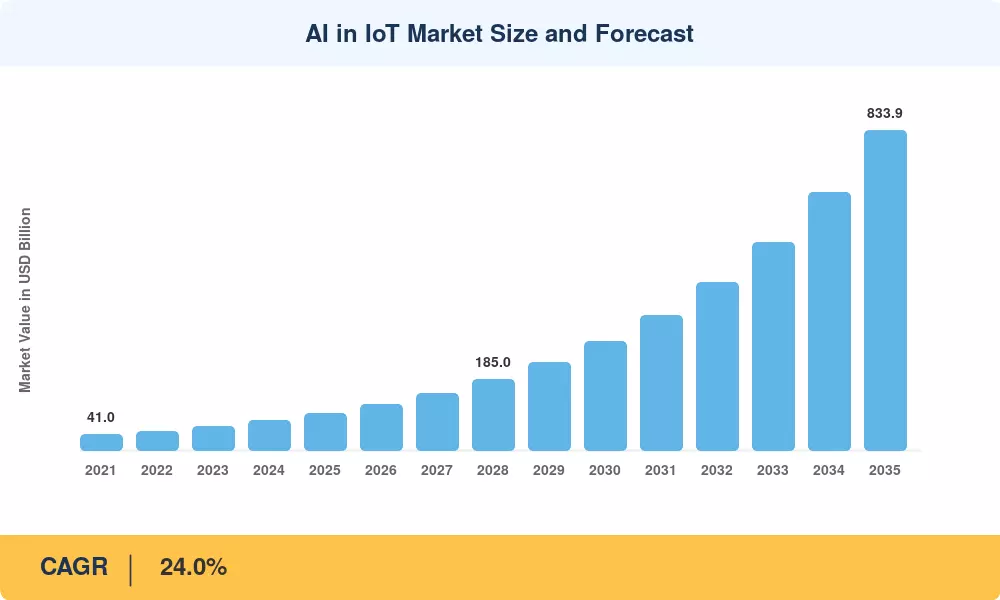
AI in IoT Market Projected to Surpass USD 833.9 Billion at 24.0% CAGR by 2035
AI in IoT Market
AI in IoT Market accelerates smart automation by enabling intelligent devices, predictive analytics, and real-time decision-making.
The AI in IoT Market is transforming connected devices into intelligent ecosystems, enabling real-time analytics, predictive automation, and smarter decision-making across industries.”
BERLIN, BERLIN, GERMANY, August 7, 2026 /EINPresswire.com/ -- The convergence of artificial intelligence and the Internet of Things is redrawing how industrial plants, hospitals, cities, and utilities operate, as billions of connected sensors move from simply collecting data to actively interpreting it in real time. AI-driven IoT device management platforms that fuse streaming telemetry with foundation models are steadily replacing legacy SCADA, MES, and rule-based frameworks, giving organizations the ability to predict equipment failures, optimize energy use, and automate decisions at the edge rather than waiting on a distant data center.— Market Research Future
The global AI in IoT Market reached USD 97.0 Billion in 2025 and is projected to advance to about USD 120.3 Billion in 2026, on a trajectory toward USD 833.9 Billion by 2035 at a CAGR of 24.0% across the forecast period. Two regulatory catalysts are accelerating this climb: the U.S. CHIPS and Science Act's tens of billions of dollars in semiconductor manufacturing incentives, and the EU AI Act's early-2026 implementation deadlines, which have forced enterprises to inventory and instrument every connected asset they operate.
Hyperscalers are pouring unprecedented capital into this convergence, with AI infrastructure expenditure across major cloud providers reaching roughly USD 320 billion in 2025 alone, a meaningful share of which is flowing into the data-plane orchestration layer that connects sensors, gateways, and inference engines. Machine learning for IoT data analytics currently holds the largest technology share at close to 38% of the market, since it lets plants monetize sensor estates they have already deployed rather than forcing a costly hardware refresh, while intelligent edge computing is the fastest-growing segment as latency-sensitive use cases in robotics and safety-critical sensing cannot tolerate a round trip to the cloud.
Get a Sample PDF of the Report at -
https://www.marketresearchfuture.com/sample_request/11757
Market Dynamics: Drivers, Restraints and Opportunities
Falling costs for edge inference silicon are among the strongest structural tailwinds behind the AI in IoT Market. The price per trillion operations per second on edge-class AI accelerators fell by roughly 38% between 2022 and 2025, and platforms from major chipmakers now compete on a cost curve reminiscent of what GPUs experienced for data-center training a decade earlier. That decline is letting gateway and sensor manufacturers embed inference at price points that were simply out of reach a few years ago, unlocking predictive maintenance use cases in mid-tier industrial plants that previously could not justify the investment.
Government-backed industrial AI mandates are compounding this momentum. Europe's Digital Europe Programme has committed billions of euros to AI and high-performance computing through 2027, with explicit funding carve-outs for AIoT pilots in heavy industry, while Germany's Plattform Industrie 4.0 and Japan's Society 5.0 framework operate as parallel demand engines. Meanwhile, predictive maintenance itself has become a proven value driver: independent research suggests it can cut unplanned downtime by roughly a third to a half and extend asset life by a comparable margin, an ROI case that is increasingly uncontested among industrial buyers. The rollout of 5G is adding further tailwind, with global connections projected to surpass 5.5 billion by 2030 and private campus networks scaling quickly across Korea, Japan, and Germany, unlocking sensor density that was previously uneconomic on legacy cellular standards.
Even against this backdrop, the market faces real friction. Connected operational technology has seen a marked rise in cybersecurity incidents in recent years, and emerging device-security certification requirements are adding meaningfully to typical bill-of-materials costs, slowing expansion among mid-market buyers until that overhead amortizes. A well-documented global shortage of skilled AI and IoT systems engineers, running into the millions of unfilled roles by decade's end, is another persistent constraint, with senior AIoT architect wages in North America climbing sharply in recent years and slowing greenfield projects outside the largest enterprises. Fragmented standards are a further drag: competing protocols coexist uneasily, and industry working groups still estimate that true interoperability benchmarks remain several years away, with integration consulting fees at some organizations already exceeding what they spend on hardware itself.
These pressures are also opening substantial new opportunities. Compressing foundation models small enough to run on gateway-class silicon represents the next major inflection point, with vendors that successfully tune sub-billion-parameter models for time-series telemetry positioned to unlock meaningful pricing power. Emerging-market smart infrastructure programs, including large government commitments to connected urban infrastructure in India and parallel digital master plans across Southeast Asia, represent a multi-decade tailwind for vendors willing to build for the price-performance tier these governments will actually tolerate. The shift from hardware sales toward outcome-based contracts -- uptime guarantees, energy-savings shares, throughput commitments -- is giving vendors a route to recurring, higher-margin revenue, and expanded reimbursement for remote patient monitoring in the United States has meaningfully de-risked the venture math for early-stage healthcare AIoT entrants.
Key Players and Competitive Insights
The AI in IoT Market remains moderately fragmented, with the top five vendors together holding an estimated 38% to 42% of global revenue and a long tail of vertical specialists filling out the remainder. Market concentration is trending gradually upward as hyperscalers absorb mid-market platform vendors, though the landscape sits comfortably below thresholds typically associated with a concentrated market.
Leading companies in the global AI in IoT Market include Microsoft, Amazon Web Services, Google, Siemens, IBM, Cisco, PTC, Schneider Electric, NVIDIA, and Bosch. Microsoft is pursuing enterprise platform breadth through its Azure IoT and Defender for IoT offerings, while AWS emphasizes edge-to-cloud orchestration through IoT Greengrass, SiteWise, and FleetWise. Google differentiates through AI and machine learning capability layered onto its Cloud IoT and Vertex AI platforms, and Siemens leverages deep operational-technology incumbency through MindSphere and Industrial Edge. IBM targets asset-intensive industries through Watson IoT and the Maximo Application Suite, Cisco leans on network-layer control following its Splunk acquisition, and NVIDIA anchors the edge AI silicon and developer-tooling layer through its Jetson, Metropolis, and Isaac platforms.
Buy this Premium Research Report at - https://www.marketresearchfuture.com/checkout?currency=one_user-USD&report_id=11757
Market Segmentations
By Component
● Platforms
● Software Solutions
● Services
By Technology
● Machine Learning and Deep Learning
● Natural Language Processing
● Computer Vision
● Digital Twins
By Vertical
● Manufacturing
● Energy and Utilities
● Transportation and Mobility
● BFSI
● Government and Defense
● Retail
● Healthcare and Life Sciences
● Telecom
● Others (Agriculture, Education, Tourism and Hospitality)
By Deployment
● Edge-Based AIoT
● Hybrid AIoT
● Cloud-Based AIoT
By Region
● North America
● Europe
● Asia-Pacific
● South America
● Middle East & Africa
Regional Insights
North America anchors the AI in IoT Market with roughly 35% of global share, supported by federal research pipelines and a dense base of industrial automation buyers. The United States dominates regional volume, powered by CHIPS Act manufacturing incentives and defense-linked autonomous-systems programs, while Canada's strength is concentrated in mining and resource extraction, where AIoT-enabled haul-truck telemetry is nearing saturation among major operators. Mexico's growth is largely downstream of U.S. nearshoring, with auto-component plants instrumenting to meet OEM
telemetry mandates.
Europe holds the second-largest position, anchored by Germany's vast base of mid-cap manufacturers running long-cycle process-instrumentation investments now layered with machine learning. The EU AI Act's risk-tiered obligations are turning 2025 through 2027 into a compliance-driven spending window that disproportionately favors platform vendors with mature governance tooling, while the United Kingdom is carving a parallel, lighter-touch regulatory path that is attracting AIoT research investment.
Asia-Pacific is the fastest-growing region, expanding at roughly 27.8% CAGR through 2035, a rate driven heavily by China and India. China's national industrial strategy has explicitly prioritized AI-enabled IoT, channeling subsidized credit into domestic platform vendors, while India's combination of manufacturing incentives, digital infrastructure investment, and the world's largest greenfield 5G rollout makes it the fastest individual country market in the space. South America and the Middle East & Africa remain smaller in absolute terms, led respectively by Brazil's globally relevant precision-agriculture footprint and state-led megaprojects across the UAE and Saudi Arabia that embed AIoT as foundational infrastructure.
Browse A Full Report: (Including Full TOC, List Of Tables & Figures, and Chart) -https://www.marketresearchfuture.com/reports/ai-in-iot-market-11757
Recent Developments
Vendors have been moving quickly to converge their AI and IoT product lines. Microsoft launched Azure AI Foundry with native IoT telemetry connectors, signaling a deliberate merger of its enterprise AI and industrial IoT offerings, while NVIDIA unveiled foundation models tuned for physical AI robotics, positioning its platform squarely for factory and logistics applications. Siemens expanded its partnership with AWS to bring MindSphere workloads onto the cloud platform by default, backed by co-engineered edge gateways built specifically for manufacturing environments.
On the regulatory side, the European Commission issued binding guidance under the EU AI Act covering high-risk AIoT systems in critical infrastructure, with compliance milestones beginning in early 2026. Cisco completed its acquisition of Splunk, folding AIoT telemetry observability into a unified security and operations stack, and the U.S. Department of Energy awarded billions of dollars across dozens of grid-resilience projects, many of which embed AIoT-enabled distribution sensing. IBM also released an updated version of its Maximo Application Suite featuring generative-AI work-order summarization, while Bosch committed roughly a billion euros toward AIoT investment focused on software-defined vehicle platforms.
Frequently Asked Questions (FAQs)
Q1. What is the expected growth of the AI in IoT Market?
The market is projected to grow at a CAGR of 24.0% from 2026 to 2035, reaching about USD 833.9 Billion by 2035.
Q2. What factors are driving the AI in IoT Market?
Falling edge inference silicon costs, industrial AI mandates, predictive maintenance adoption, and 5G rollouts are major growth drivers.
Q3. Which region dominates the AI in IoT Market?
North America currently leads with roughly 35% of global share, supported by federal R&D pipelines and dense industrial automation demand.
Q4. What are the major challenges facing the market?
Cybersecurity incidents on connected OT, a global AI/IoT talent shortage, and fragmented interoperability standards remain key challenges.
Q5. Which technology segment holds the largest share?
Machine learning for IoT data analytics leads with about 38% share, while intelligent edge computing is the fastest-growing technology segment.
Q6. Who are the leading companies in the AI in IoT Market?
Major players include Microsoft, Amazon Web Services, Google, Siemens, IBM, Cisco, PTC, Schneider Electric, NVIDIA, and Bosch.
Q7. Which vertical is growing the fastest?
Healthcare is the fastest-growing vertical, expanding at roughly a 26.9% CAGR, driven by expanded remote patient monitoring reimbursement.
➤➤ Regional & Country-Level Reports by Market Research Future:
Europe AI in IoT Market -
https://www.marketresearchfuture.com/reports/europe-ai-in-iot-market-65628
GCC AI in IoT Market -
https://www.marketresearchfuture.com/reports/gcc-ai-in-iot-market-65626
US AI in IoT Market -
https://www.marketresearchfuture.com/reports/us-ai-in-iot-market-14859
UK AI in IoT Market -
https://www.marketresearchfuture.com/reports/uk-ai-in-iot-market-65620
South Korea AI in IoT Market -
https://www.marketresearchfuture.com/reports/south-korea-ai-in-iot-market-65621
Germany AI in IoT Market -
https://www.marketresearchfuture.com/reports/germany-ai-in-iot-market-65622
Japan AI in IoT Market -
https://www.marketresearchfuture.com/reports/japan-ai-in-iot-market-65623
France AI in IoT Market -
https://www.marketresearchfuture.com/reports/france-ai-in-iot-market-65624
Canada AI in IoT Market -
https://www.marketresearchfuture.com/reports/canada-ai-in-iot-market-65625
Sagar Kadam
Market Research Future
+ +1 628-258-0071
email us here
Legal Disclaimer:
EIN Presswire provides this news content "as is" without warranty of any kind. We do not accept any responsibility or liability for the accuracy, content, images, videos, licenses, completeness, legality, or reliability of the information contained in this article. If you have any complaints or copyright issues related to this article, kindly contact the author above.
