

Physical Security Market Expands at a 5.40% CAGR Through 2035
Physical Security Market
Physical Security Market Size, Share and Research Report By Type (System, Service), By Industry (Education, Oil & Gas, Government, Retail, Hospitality, BFSI)
Physical Security Market is witnessing strong growth as organizations invest in intelligent surveillance, access control, and threat detection to protect people and assets.”
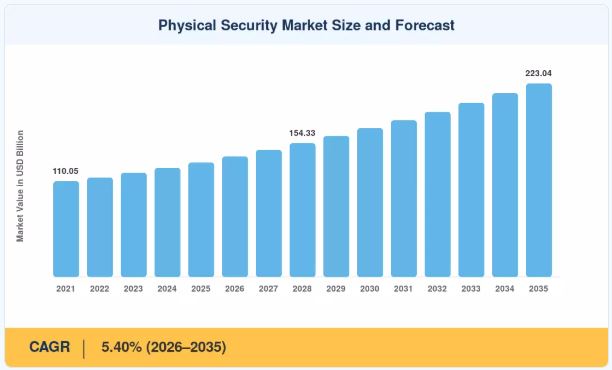
NEW YORK,, NY, UNITED STATES, August 7, 2026 /EINPresswire.com/ -- The Global Physical Security market stood at USD 131.80 billion in 2025 and is projected to reach USD 138.92 billion in 2026 before climbing to USD 223.04 billion by 2035, registering a 5.40% CAGR across the 2026–2035 forecast window. Escalating geopolitical tensions, rising urban crime rates, and government mandates such as the U.S. Department of Homeland Security's USD 3.2 billion annual allocation for critical-infrastructure protection anchor near-term demand. Enterprise spending on physical security continues to accelerate even in constrained budget environments because insurers increasingly tie premium reductions to verified surveillance and access-control deployments. — Market Research Future (MRFR)
The market's 5.40% CAGR reflects the convergence of government infrastructure-protection mandates (~1.3% impact), AI-powered analytics and edge computing (~1.1%), smart-city and urban-surveillance expansion (~0.9%), and cloud migration toward as-a-service models (~0.8%) accelerating across the world's most security-conscious government and enterprise procurement channels simultaneously.
A sweeping technology shift defines this decade. Legacy analog CCTV arrays and standalone card-reader systems are giving way to IP-networked cameras with on-device AI processing, cloud-managed access credentials, and unified command platforms that merge intrusion detection with cybersecurity dashboards. The European Union's AI Act, effective from 2025, compels vendors to reclassify certain facial-recognition deployments while simultaneously validating the regulatory permanence of intelligent surveillance, a dynamic that drives both compliance spending and product redesign.
North America retains the dominant share of the market at roughly 36.5% of global revenue, backed by federal procurement cycles and a mature integration-services ecosystem. Asia-Pacific is the fastest-growing region, registering a projected 6.50% CAGR fueled by smart-city rollouts in China, India, and Southeast Asia. Europe holds the second-largest position, contributing approximately 26.0% of revenue as GDPR-adjacent regulations sustain demand for privacy-compliant surveillance architectures. Physical security is evolving from point-product procurement toward platform-centric, subscription-driven security ecosystems as edge computing and 5G connectivity mature.
Get Full PDF Sample Copy of Report: (Including Full TOC, List of Tables & Figures, Chart) @
https://www.marketresearchfuture.com/sample_request/2783
➤ How Significant Is the Physical Security Market's Growth?
The physical security market's trajectory from USD 131.80 billion in 2025 to a projected USD 223.04 billion by 2035 represents a durable, compliance-anchored expansion over the forecast decade, reflecting the structural shift from point-product hardware procurement toward unified, AI-augmented security platforms deployed across government, banking, and critical-infrastructure environments. The market's 5.40% CAGR is anchored in a regulatory-and-technology convergence cycle where federal infrastructure-protection mandates, insurer-driven adoption incentives, and cloud-subscription economics are all pushing physical security spend from discretionary capital expenditure to compliance-mandated operating expenditure.
Video surveillance systems commanded the largest segment of the market with approximately 47.0% revenue share in 2025, driven by enterprise-wide camera refresh cycles and smart-city procurement programs, while biometric systems are projected to expand at the fastest pace, registering a 7.05% CAGR through 2035 as airports, corporate campuses, and government facilities accelerate contactless identity verification.
VSaaS accounted for the dominant share among service offerings at 56.0% in 2025, reflecting the industry's shift toward recurring cloud-hosted revenue models, while ACaaS is poised for the highest service growth trajectory at a 7.35% CAGR as mobile-credential adoption and multi-site management platforms fuel enterprise uptake. Government services captured USD 40.71 billion of the market in 2025, the largest end-user vertical, though residential applications will register the fastest growth at 6.40% CAGR as smart-home ecosystems integrate professional-grade perimeter monitoring with consumer IoT platforms.
➤ What Does the Future Hold for the Physical Security Market?
Government infrastructure-protection mandates contribute approximately 1.3 percentage points to the physical security market's CAGR the single highest driver impact. The U.S. Cybersecurity and Infrastructure Security Agency expanded its Physical Security Convergence guidance in 2024, requiring federally funded facilities to integrate intrusion-detection layers with network-monitoring platforms. Parallel legislation in the EU, notably the Critical Entities Resilience Directive, obligates operators in energy, transport, and healthcare to upgrade physical access controls by 2026, creating a compliance-driven spending floor estimated at EUR 4.8 billion across member states and guaranteeing baseline demand even during macroeconomic downturns.
AI-powered analytics and edge computing contribute approximately 1.1 percentage points to the CAGR, establishing intelligent camera hardware as a primary near-term demand source. On-camera inference engines now run object-classification, loitering-detection, and behavioral-anomaly models at the network edge, reducing bandwidth costs by up to 60% compared with centralized cloud processing.
Vendors like Hanwha Vision and Axis Communications shipped AI-equipped camera lines throughout 2024, while chipmakers Ambarella and Qualcomm released purpose-built vision SoCs priced below USD 15 per unit at volume, a threshold that makes AI standard rather than premium and elevates the average selling price of surveillance nodes by an estimated 18–22%. Smart-city and urban-surveillance expansion adds a further 0.9% to the CAGR, with China's Safe City initiative having deployed over 600 million surveillance cameras nationwide and India's Safe City Project sanctioning approximately USD 460 million for smart surveillance across 15 cities during Phase I.
The next product generation is shifting from siloed hardware procurement toward AI-autonomous security operations platforms that ingest data from cameras, radar, lidar, access-control logs, and environmental sensors to generate threat assessments without human triage. This translates into a value migration from hardware sales toward software-platform licensing and managed-detection-and-response subscriptions, with platform-attached recurring revenue projected to account for over 40% of the market by 2034, up from roughly 22% in 2025.
By 2032, over 60% of enterprise security budgets are expected to be allocated through converged physical-cyber governance structures rather than siloed departments, amplifying the addressable market by folding in cybersecurity-adjacent spend and creating a new competitive dynamic where cybersecurity specialists intersect with traditional physical-security incumbents.
Get access to the full description of the report @
https://www.marketresearchfuture.com/reports/physical-security-market-2783
➤ Who Are the Key Players in the Physical Security Market?
The physical security market exhibits medium concentration with an estimated HHI of approximately 800–1,000, indicating that no single vendor dominates but a tier of five to seven global incumbents collectively holds 35–40% of revenue. Competition plays out across three dimensions: geographic reach, product-portfolio breadth spanning hardware, software, and services, and channel-partner density, with M&A activity intensifying since 2022 as software-platform companies acquire camera and sensor OEMs to assemble end-to-end stacks. MRFR identifies the following key participants with estimated revenue share ranges:
Honeywell International (~6–9% share) - an integrated building-automation and security convergence leader providing Connected Buildings, Pro-Watch access control, and video management, leveraging its broader industrial-automation footprint to bundle security within larger facility contracts.
Johnson Controls International (~5–8% share) - a global install-base leader providing Tyco-branded intrusion, video, and access-control products, having formed a strategic partnership with Microsoft to deploy Azure-hosted OpenBlue security-and-sustainability services.
Robert Bosch GmbH (~4–7% share) - an engineering-led R&D specialist providing video surveillance, intrusion detection, and communication systems, with particularly deep market share and channel presence across the European Union.
Hangzhou Hikvision Digital Technology (~7–10% share) - a volume-manufacturing leader providing IP cameras, NVRs, and AI-analytics platforms, pursuing aggressive international pricing that has made it one of the largest camera suppliers globally.
Zhejiang Dahua Technology (~4–6% share) - a cost-competitive portfolio provider offering IP cameras, thermal imaging, and access control, with a growing OEM channel supplying private-label hardware to regional integrators.
Axis Communications, a Canon Group company (~3–5% share) - a premium positioning specialist providing network cameras, radar, audio, and video management software, maintaining strong integrator loyalty through open-architecture design.
ASSA ABLOY (~3–5% share) - an access-control dominance leader providing electronic locks, mobile credentials, and door hardware, with entrenched distribution across commercial and institutional building channels.
Motorola Solutions (~3–5% share) - a video-analytics leadership player providing Avigilon video, access control, and license-plate recognition, having completed the acquisition of Noggin to embed critical-event management into its ecosystem.
Genetec (~2–4% share) - an open-architecture software platform provider offering the Security Center unified platform and AutoVu LPR, cultivating a broad independent-software-vendor ecosystem around its core platform.
Allegion (~2–3% share) - a focused access-control specialist providing Schlage electronic locks and Von Duprin exit devices, serving an established institutional and educational-facility channel.
Strategic competition in the physical security market is increasingly defined by platform-attached recurring revenue and open-standards interoperability with high false-alarm rates in legacy systems, estimated at 94–98% of the roughly 36 million annual U.S. alarm activations, cited as a persistent adoption barrier alongside privacy and data-sovereignty regulations, semiconductor supply-chain disruptions, and a shortage of skilled workforce for system integration across North America and Europe.
➤ What Are the Emerging Trends in the Physical Security Market?
Several transformational trends are redefining the physical security market's evolution through 2035:
Government Infrastructure-Protection Mandates: Expanded CISA Physical Security Convergence guidance and the EU's Critical Entities Resilience Directive are obligating federally funded and critical-infrastructure operators to integrate intrusion-detection layers with network-monitoring platforms, creating a compliance-driven spending floor estimated at EUR 4.8 billion across EU member states alone.
AI-Powered Analytics and Edge Computing: On-camera inference engines now run object-classification, loitering-detection, and behavioral-anomaly models at the network edge, cutting bandwidth costs by up to 60%, while purpose-built vision SoCs priced below USD 15 per unit at volume are making AI capability a standard rather than premium feature.
Smart-City and Urban-Surveillance Expansion: China's Safe City initiative has deployed over 600 million surveillance cameras nationwide, and India's Safe City Project has sanctioned approximately USD 460 million for smart surveillance across 15 cities during Phase I, with Southeast Asian economies following through World Bank and Asian Development Bank-linked municipal tenders.
Unified Physical-Cyber Security Platforms: Enterprises that combine badge access, video telemetry, and network-anomaly detection onto a single pane are reporting mean-time-to-respond reductions of up to 40%, positioning vendors with API-first solutions spanning OT and IT domains for incremental revenue capture.
Drone-Based Surveillance and Autonomous Patrol: Autonomous security drones, both tethered and free-flying, are addressing persistent labor shortages in perimeter patrol for warehouse parks, solar farms, and data-center campuses, with relaxing beyond-visual-line-of-sight regulations across the U.S. and Europe positioning drone surveillance as a high-margin adjacency.
Buy Full Research Report:
https://www.marketresearchfuture.com/checkout?currency=one_user-USD&report_id=2783
➤ How Is the Physical Security Market Segmented?
The physical security market report provides a comprehensive segmentation framework:
By System Type: Video Surveillance Systems (47.0% share, 2025), Physical Access Control Systems (USD 38.33 billion, 2025), Intrusion Detection Systems (5.20% CAGR), Biometric Systems (7.05% CAGR)
By Service Type: VSaaS (56.0% share, 2025), ACaaS (7.35% CAGR)
By Deployment: On-Premises (66.0% share, 2025), Cloud (7.10% CAGR)
By Organization Size: Large Enterprises (62.0% share, 2025), Small & Medium Enterprises (7.70% CAGR)
By End-User Industry: Government Services (31.5% share), BFSI (USD 21.90 billion, 2025), Transportation & Logistics (5.60% CAGR), Retail (USD 13.18 billion, 2025), Residential (6.40% CAGR), Healthcare (5.50% CAGR)
By Region: North America (36.5%), Europe (26.0%), Asia-Pacific (6.50% CAGR), South America (USD 8.57 billion), Middle East & Africa (USD 8.57 billion)
➤ What Are the Regional Insights from the Physical Security Market?
North America retains the dominant share of the physical security market at roughly 36.5% of global revenue in 2025, with the United States commanding 78.0% of regional share through federal procurement including DHS, DoD, and GSA schedules alongside a private-sector installed base exceeding 85 million networked cameras. The NDAA Section 889 ban on certain Chinese-manufactured equipment triggered a multi-year replacement cycle valued at an estimated USD 4–6 billion, benefiting compliant manufacturers. Canada contributes 12.5% of regional share through cannabis-facility surveillance requirements that sustain per-site camera densities three to four times higher than typical retail, and Mexico adds 9.5% through banking-sector security modernization mandated by its regulator, the CNBV.
Asia-Pacific is the fastest-growing region in the physical security market, posting a projected 6.50% CAGR through 2035, with China commanding 38.0% of regional share through its Safe City and Skynet programs and an installed surveillance camera base surpassing 600 million units. India is posting a 7.20% CAGR within the region through its Safe City Project and metro-rail expansion, with the Union Budget 2024–2025 allocating approximately INR 11,500 crore to the Smart Cities Mission. Japan contributes USD 5.20 billion through Olympic-legacy and earthquake-resilience integration, South Korea is growing at a 6.80% CAGR through smart-factory and semiconductor-fab security requiring cleanroom-grade access control, and ASEAN contributes USD 4.10 billion through airport and port modernization.
Europe accounts for approximately 26.0% of global physical security market share, with the United Kingdom contributing USD 8.91 billion through counter-terrorism urban surveillance and Germany posting a 5.15% CAGR through Industry 4.0 factory-perimeter security. France is growing at a 5.30% CAGR as post-2024 Olympic security infrastructure in Paris and Lyon is repurposed for transit and venue applications, Italy contributes USD 3.42 billion through heritage-site protection mandates, Spain is posting a 5.10% CAGR through tourism-sector security upgrades, and the Nordic countries contribute USD 2.85 billion through smart-building integration standards, with the EU's CER Directive and NIS2 requirements pushing critical-infrastructure operators toward auditable, standards-compliant security stacks.
South America and the Middle East & Africa each represent approximately USD 8.57 billion of 2025 physical security market revenue. Brazil commands 62.0% of South American revenue, driven by Banco Central do Brasil regulations mandating video recording at all bank branches and ATM locations, with urban violence indices sustaining residential and commercial alarm-system penetration rates above 30%, while Argentina is growing at a 5.00% CAGR as Buenos Aires targets 40,000 connected cameras by 2027 under its City of Cameras program. In the Middle East & Africa, Saudi Arabia commands 32.0% of regional share through NEOM and Vision 2030 mega-projects that alone are expected to deploy over 100,000 networked cameras and AI-enabled perimeter sensors, the UAE is growing at a 6.40% CAGR through Expo-legacy and smart-city ambitions, and South Africa contributes USD 1.20 billion through formalization of its private-security industry, which employs more than 2.7 million registered officers.
➤➤➤ Regional & Country-Level Reports by Market Research Future:
US Physical Security Market -
https://www.marketresearchfuture.com/reports/us-physical-security-market-14164
UK Physical Security Market -
https://www.marketresearchfuture.com/reports/uk-physical-security-market-49032
Germany Physical Security Market -
https://www.marketresearchfuture.com/reports/germany-physical-security-market-49034
France Physical Security Market -
https://www.marketresearchfuture.com/reports/france-physical-security-market-49037
Italy Physical Security Market -
https://www.marketresearchfuture.com/reports/italy-physical-security-market-49038
Japan Physical Security Market -
https://www.marketresearchfuture.com/reports/japan-physical-security-market-49035
South Korea Physical Security Market -
https://www.marketresearchfuture.com/reports/south-korea-physical-security-market-49033
North America Physical Security Market -
https://www.marketresearchfuture.com/reports/north-america-physical-security-market-49036
APAC Physical Security Market -
https://www.marketresearchfuture.com/reports/apac-physical-security-market-49041
Sagar Kadam
Market Research Future
+ +1 628-258-0071
email us here
Legal Disclaimer:
EIN Presswire provides this news content "as is" without warranty of any kind. We do not accept any responsibility or liability for the accuracy, content, images, videos, licenses, completeness, legality, or reliability of the information contained in this article. If you have any complaints or copyright issues related to this article, kindly contact the author above.
